| | NIKE MISSILE
BATTERY NY-56 | FORT HANCOCK, NEW JERSEY |
|
| |
|
A Brief Historical Overview Of Nike Missile Battery NY-56 |
 |
|
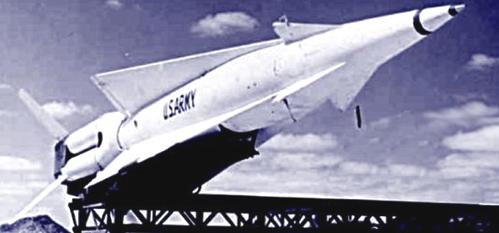
Nike missile battery NY-56 at Fort Hancock, New Jersey, was one of 19 Nike missile sites constructed to defend the New York metropolitan area against an air attack by Soviet bombers during the Cold War.
The site consisted of two primary facilities. The Control Area (also known as the IFC or Integrated Fire Control Area) contained the radars needed to detect and track hostile aircraft. Another radar tracked the missile during its flight and transmitted computer-generated steering commands, directing it to intercept its target. The analog missile guidance computer was also located at the Control Area.
The separate Launcher Area, located roughly one mile south of the Control Area, was where the missiles were assembled, tested, and stored within underground magazines until they were required. The missiles were brought to the surface of the site and erected upon launchers prior to firing. Although frequent exercises were held, no missiles were ever fired from Sandy Hook.
Site NY-56 was one of a small number of double Nike missile batteries containing two missile batteries. Each battery was capable of independent operation. The Launcher Area had four of the larger B type underground missile magazines designed for the larger Nike Hercules missiles, although they could be used with either the Ajax or Hercules types. The Control Area contained two IFC Areas (one for each missile battery). Ech had its own compliment of radars, radar display equipment, early warning plotting boards and computers.
The Nike Ajax missiles first deployed at the site had a maximum range of roughly 30 miles and were armed with conventional, high explosive warheads. Each underground missile magazine was capable of holding ten fully assembled Nike Ajax missiles for a total of 40 missiles.
During 1958-1959, site NY-56 was converted to the second-generation Nike missile system known as the Nike Hercules. The Nike Hercules offered greatly improved performance over the earlier Ajax missiles it replaced. It also offered much greater range (roughly 90 miles). Perhaps most significantly, it could be armed with powerful nuclear warheads capable of destroying a formation of several closely-spaced aircraft. Each of the four converted missile magazines was capable of holding up to six of the larger Nike Hercules missiles.
The IFC Area was upgraded at this time to include more powerful Nike Hercules system radars as well as powerful long-range acquisition radars known as ABAR (Alternate Battery Acquistion Radar) and HIPAR (High Power Acquisition Radar). A Target Ranging Radar which was resistant to enemy attempts to electronically jam the tracking system was also introduced with the Improved Nike Hercules System.
Site NY-56 was established during late 1953 under the Army�s 526th Anti-Aircraft Missile Battalion. Beginning in September 1958, the Nike units were reorganized with the 4th Battalion, 71st Artillery, assuming operation of the site. A final reorganization occurred during June 1964 when the 3rd Battalion of the 51st Artillery commenced air defense operations at the Fort Hancock Nike installation.
Nike battery NY-56 remained operational through 1974 when the nationwide Nike missile system was inactivated. U.S. Army Air Defense Command (ARADCOM) which operated the Nike batteries was inactivated during 1975.
To contact the author, please
click here to send e-mail
to Don Bender at [email protected]
|
| |
| Enhanced U.S. Army photo by D. E. Bender. |
|
|
| SITE
CURATOR: DONALD E. BENDER E-Mail: [email protected]
|